One at a Time: Why the Lathe Cut Is Doing the 7-Inch's Old Job
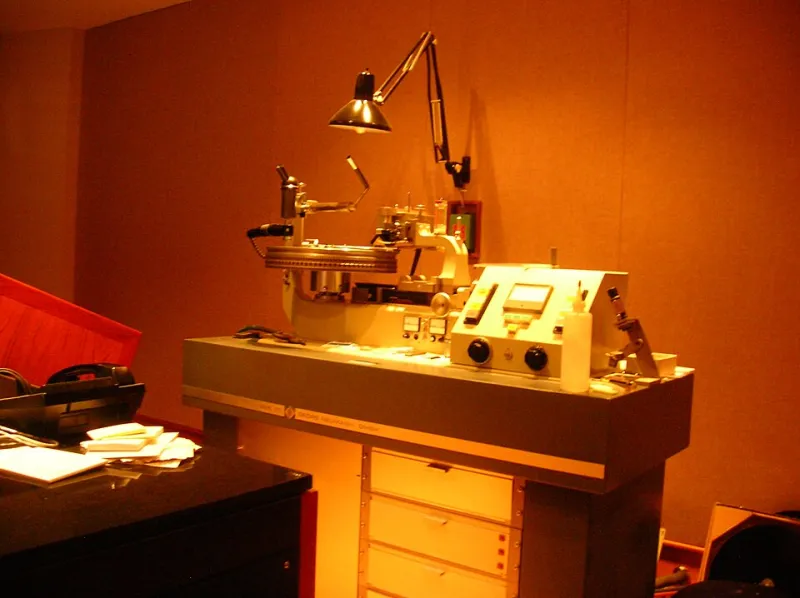
Photo: VACANT FEVER, CC BY-SA 2.0, via Wikimedia Commons
There's a particular sound in a room where someone is cutting a record by hand. Not the music — the room. A faint, high whirr from the lathe, the tick of a chip tube pulling away a thread of acetate, a person standing very still because they are, in the most literal sense, performing the pressing.
That's the thing about lathe cuts: there's no pressing. No stampers, no test pressings, no pallet of 300 arriving six months later with a warp in the top three. Someone sits at a modified lathe and cuts each disc individually, in real time. Three minutes of music means three minutes of cutting. Then they do it again, and again, until the edition is done.
It used to be a novelty. Something you saw at a fair, next to a hand-pulled screenprint. In the last couple of years it's turned into infrastructure — the small, sensible, deeply unglamorous format that a lot of UK underground releases now lean on when a 7-inch would be lovely and a 7-inch is also, frankly, a bit of a gamble.
The maths that killed the casual single
Ask anyone who has put out a short-run record in the last few years and they'll tell you the same story. Pressing plant lead times have come down from their worst, but the minimums haven't. A band with two songs and a thousand followers doesn't want 300 copies. They want 50. They want 75. Enough to sell at the shows they've actually booked, with maybe a handful left over for a distro in Bristol or a shop in Leeds that has been kind enough to take a punt.
A lathe run of 50 is achievable in an afternoon. A lathe run of 50 also doesn't require you to guess how the record will sound after it has been pressed from a laquer, sent to a plant, plated, and stamped — because the disc you're holding is the disc someone cut. If it's a good cut, that's what everyone gets.
The trade-off is real and nobody pretends otherwise. Lathe cuts are quieter, especially at the inner grooves. They wear faster than pressed vinyl. Surface noise is part of the deal, not a defect. Some of them are cut on polycarbonate rather than acetate, which changes the timbre — a slightly harder, more brittle edge that some people love and some people find unnerving. If you're making a record for a DJ, this is not the format. If you're making a record for someone who is going to put it on at home and sit down, it absolutely is.
The return of the artefact
Here's where it gets interesting. The 7-inch used to be the format that carried a band's personality. Picture sleeves, hand-stamped labels, a lyric insert folded into a paper bag, the whole thing costing less than a round. Those records weren't important because of their fidelity. They were important because they existed, and because there were only a few hundred of them, and because you had one.
Lathe cuts have wandered straight into that gap. Because each disc is cut individually, the edition is genuinely limited in a way that a 'limited pressing of 500' on coloured vinyl has never quite been. Numbered sleeves are easy. Handwritten labels are easy. A band can cut 40 at a session and trade a few with the support act at the next gig, which is exactly what used to happen with 7-inches and almost never happens with a proper pressing run because the economics are too tight.
We've seen them turn up as tour merch, as tour-only singles, as split releases between two artists splitting a single afternoon on the lathe, as fundraiser items for a venue's legal fees, as wedding presents, as apologies. The format is flexible in a way that pressing isn't, because you can decide to make ten more without reordering anything.
What it costs, and who's doing it
A handful of small UK cutting operations have built a quiet trade on this. Most work at a scale where you email them, agree a date, send files, and turn up — or post them. Prices vary, but a short run of lathe-cut 7-inches typically lands somewhere between the cost of a decent run of CDs and a small pressing, once you account for the fact that you're paying for a person's time rather than a machine's throughput. Turnaround is measured in days, not seasons.
The practical advice from people who do it a lot is boring and worth repeating. Send files that are already mastered for the format — loud, mono-checked, and with the loudest track on the outside of the disc. Keep the runtime sensible. Don't put a five-minute track on a 7-inch and expect it to sound like a 12-inch. Tell the cutter what you're doing with it, because a disc going into a DJ bag needs different treatment to one going into a frame.
And be honest about the listening. A lathe cut is a piece of furniture as much as a piece of audio. That's not a slight. Some of the best records in any collection are there because of what they are, not because they're the definitive pressing.
The 7-inch didn't die, it just got smaller
There's a temptation to frame this as a rivalry — lathe cuts versus the 7-inch, craft versus industry. It isn't really. The 7-inch is still the yardstick: the shape, the sleeve, the two-songs-and-out discipline. What's changed is that the underground has stopped assuming the only legitimate way to make one is to order hundreds of them from a plant and hope.
A lathe cut says something different about a release. It says: this exists in the world in a number you could count on your hands, and someone made it this week, and you can hear the effort in it. In a scene that has spent years arguing about the ethics of the pre-order and the wisdom of the 300-press, that's not a compromise. It's a correction.
So yes — the lathe cut is the new 7-inch, in the sense that it's the format doing the job the 7-inch used to do: cheap enough to be reckless, beautiful enough to keep, and scarce enough that it means something when you find one in a rack. The whirr is the point. So is the wait while it happens.