One Kit, Five Bands: The Shared Backline Holding UK Underground Shows Together
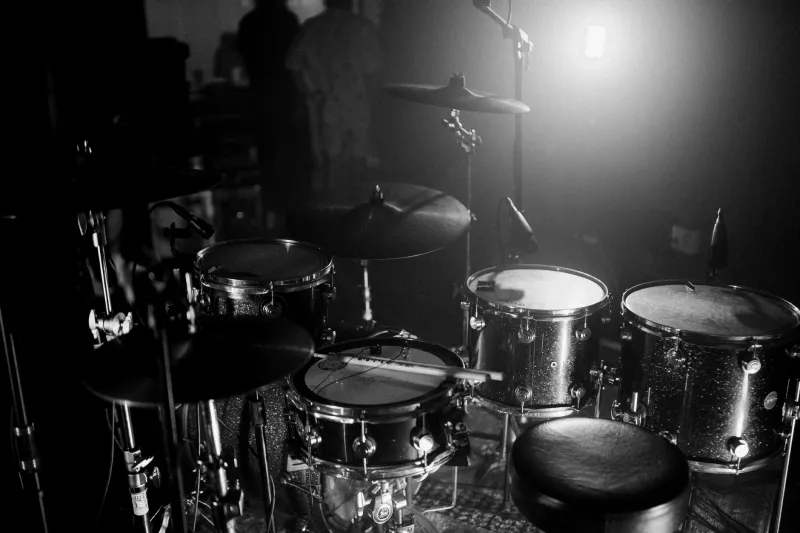
There's a moment at almost every small UK show where a drummer you've never met leans over the kit, adjusts the hi-hat clutch a quarter turn, and says "cheers, mate" to the person who owns it. That's it. That's the whole transaction. No paperwork, no deposit, no van. Just two people who've decided, in about four seconds, that the night will go better if they trust each other.
That moment is the backline pool, and in 2026 it's quietly doing more for the UK underground than most of the things we write about.
What a backline pool actually is
Strip away the romance and it's a shared pile of gear with a rota attached. A drum kit that lives at a venue, or in a lock-up, or in the back of someone's estate car, and gets played by three or four bands in an evening. A bass amp that gets carried in once and stays put. A spare snare in case the head goes. Cables. Always cables.
Sometimes it's formalised: a promoter keeps a house kit behind the bar, a label maintains a small stock of amps for its own roster's shows. More often it's a group chat. Someone posts "anyone got a spare kick pedal for Thursday", and someone does.
The distinction that matters is between breakables and shells. Cymbals, snare, pedals, and your own sticks travel with the drummer. Shells, hardware, and generally the bass amp stay put. That line is old, and it's held because it respects the two things a musician is precious about: the bits that touch them, and the bits that cost the most to replace.
The maths of not driving a van
Hiring a van for a single night is a fairly miserable way to spend money you didn't really have. Between the hire itself, fuel, a lock-up if you can't park it outside your flat, and the low-level dread of a wing mirror, the cost lands on a band before anyone's been paid for anything.
Now multiply that by four bands playing a 200-cap room. Four vans, four load-ins, four times the congestion in the alley behind the venue. It's not just money — it's time, and noise complaints, and the fact that most UK grassroots rooms have a doorway roughly the width of a supermarket trolley.
So bands started doing the obvious thing: one kit, one amp, everyone plays through it. What used to be a favour between friends is now, for a lot of touring bands, simply how you make a run of dates add up. If you're playing Leeds on Thursday and Sheffield on Friday, the question is no longer "can we afford to bring the kit" but "who's already got one in the room".
That shift is small and it's unglamorous and it's the reason some tours exist at all this year.
The bit nobody puts on the poster
Here's the honest part. Lending gear is a risk, and the scene has a habit of pretending otherwise.
Things break. Throne threads strip. A tom gets knocked off a riser. Someone's amp goes down mid-set because it was already going down and the band before them just happened to be the one on stage when it did. And then there's the awkward conversation where a person who earns their money in a completely unrelated job has to decide whether to ask a stranger for £120.
Most of the time it resolves with a shrug and a PayPal link. Occasionally it doesn't, and a friendship goes cold over a snare stand.
The unspoken insurance in all of this is proximity — you lend to people whose names you've seen on a bill, whose bandmate you've shared a rider with, who you know will be in the same rooms next month. Reputation is doing the work that a contract would do elsewhere. It's remarkably effective and it's also, by design, exclusionary: if you're new, or you've just moved to a city, you're outside the pool until somebody vouches for you.
Where labels can help without making it weird
This is the interesting question for anyone running a small label right now. There's a real gap between "everyone hopes for the best" and "everyone fills in a form", and a label is well placed to sit in the middle of it.
It doesn't need to look like a rental agreement. It can look like a shared spreadsheet listing what the label owns and where it lives. It can look like a modest gear library — a decent bass head, a workhorse kit, a couple of reliable DIs — bought once and loaned to the roster with a first-name-basis understanding about repairs. It can look like the label simply asking the question before a show: who's bringing the shells, and does everyone know?
What kills the spirit fastest is over-formalising. Nobody wants a liability waiver before they can borrow a kick drum. What protects the spirit is clarity: who owns it, who's carrying it, what happens if it goes wrong, and a general assumption that the label will not quietly eat the cost of a broken tom and resent everyone about it later.
Public liability cover, sensible storage, and a written-down list of who has what are boring things that keep nice evenings happening. Treat them as maintenance, not bureaucracy.
The etiquette is the product
If you're new to a pool, the fastest way in is to be useful. Turn up early. Help with the load-in even though it's not your gear. Bring gaffa. Don't retune someone's kit to your preferences and leave it that way. Ask before you move anything. If something's already cracked, photograph it before you play, not after — for their sake as much as yours.
And if you borrow, offer back. A label that owns a kit will always be short of someone willing to drive it across town at 11pm.
What could break it
Two things, probably. The first is cost: shell packs and decent amps are not getting cheaper, and the pool only works while enough people can afford to be generous. The second is scale: the bigger a pool gets, the more it starts to need the boring infrastructure it was built to avoid.
But the handshake has survived worse. It survives because it's cheaper than the alternative and because it's nicer than the alternative, which is a combination the UK underground has always found hard to argue with. Long may it hold.